Magazines & Books
Some of the titles listed here are out of print and only available on the antiquarian market.
Matadore der Radrennbahn
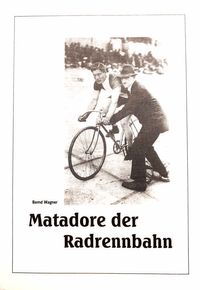
In 1999, the “Working Group of Autograph Collectors” enabled me to write a 16-page special edition entitled “Matadors of the Velodrome.”
In it, I presented a series of cycling autographs from my collection, as well as detailed portraits of the riders Willy Arend, Thorvald Ellegaard, Alfred Goullet, and Walter Rutt.
In German
Der Knochenschüttler (Nr. 39)
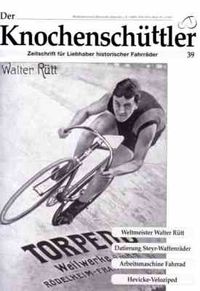
In March 2007, the association “Historische Fahrräder e.V.” (Historical Bicycles) gave me the opportunity to write a detailed article about Walter Rutt for its member magazine “Der Knochenschüttler” (The Bone Shaker).
The elaborately designed journal informs its readers three times a year about interesting topics related to bicycle history. The topics range from company profiles and repair tips to reports on collector meetings and exhibitions.
Photos of the world champion adorned both the front and back covers of issue no. 39, and the editorial team devoted six extensively illustrated pages to “Memories of an extraordinary cyclist” in the text section.
Michael Mertins, then editor-in-chief of “Der Knochenschüttler,” was responsible for the layout of the article.
In German
International Cycle Sport (März 1978)
In March 1978, this magazine published a three-page article by journalist Jim Wallace. “The Walter Rütt Story” describes in moving words the career of the world cycling champion and six-day champion. Wallace's article concludes with the words:
“There is much more that could be written about Walter Rutt; he had a charming personality and spoke several languages, including ”racing English“ as a result of his travels to Australia and the USA. We all missed him on the European racing scene when he died in West Berlin a few years ago, still lively but after the only serious illness of his life.”
Im Glanz und Schatten des Regenbogens
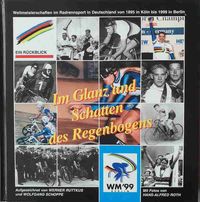
In their work, authors Werner Ruttkus and Wolfgang Schoppe meticulously describe the road and track cycling world championships held in Germany from 1895 to 1999. Walter Rutt is given extensive coverage.
The book comes highly recommended and offers 336 pages of reading pleasure.
In German
Rundenkreisel und Berliner Luft
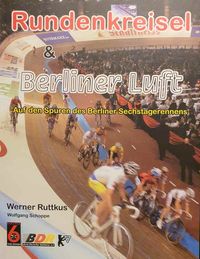
Cycling journalist Werner Ruttkus (with the support of Wolfgang Schoppe) traces the history of the Berlin Six Day Race in his book “Rundenkreisel & Berliner Luft” (Roundabout & Berlin Air).
Readers can expect an exciting journey through time from the premiere in 1909 to the 100th race in 2011. The author devotes himself to each individual event and illustrates his descriptions with a wealth of photos. A statistics section that leaves nothing out and detailed rider portraits round off the work.
Conclusion: 430 jam-packed pages and as heavy as a mail-order catalog. A reference work on cycling of this quality and scope has previously only been available for the Tour de France. It sets new standards for track cycling.
In German
The Six Day Bicycle Races
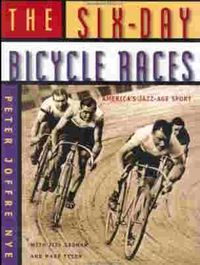
Peter Joffre Nye is an authority on the history of cycling in the USA.
In this richly illustrated book, the author describes the early years of American six-day races.
Os Wöschele (September 2013)
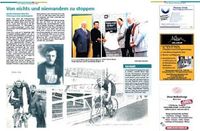
In September 2013, 18,500 households in Würselen received a free copy of the magazine “Os Wöschele,” which also brought Walter Rutt into their homes.
When I mentioned the upcoming anniversary “100 years of world champion Walter Rutt” to Bernd Schaffrath, then press spokesman for the city of Würselen and editor-in-chief of the magazine, he immediately agreed to include a two-page article in the city magazine.
In German
Geschichte des Radsports des Fahrrades
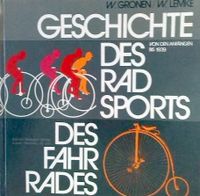
Published in 1978, this work by Wolfgang Gronen and Walter Lemke is considered the ideal introduction to the history of cycling.
In addition to the technical development of the bicycle, it describes the first races and introduces many of the greats of cycling.
In German
Begegnungen im Schatten des Herakles
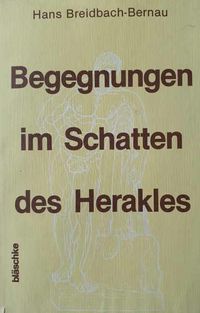
The author Hans Breidbach-Bernau dedicates his book to 25 athletes, coaches, and officials who have been particularly important to him.
In the 1950s, through the mediation of Fredy Budzinski, he met Walter Rutt at the Machnow bicycle shop and was able to talk to him at length.
The description of this meeting testifies to the author's great respect for the idol of his youth.
In German