The final lap
During World War I, Walter Rutt served as a non-commissioned officer and instructor for motorcyclists at the barracks in Langwitz. He continued to compete very successfully in sprinter's races, recording 51 victories in 53 starts in 1914.
In 1918, he divorced his wife Charlotte, with whom he had a second son named Orla. Charlotte Rutt returned to her native Denmark and opened the “Restaurant Nord” in Copenhagen together with her mother and brother Orla.
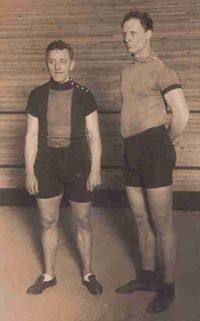
Photo: R. Sennecke Berlin
Walter Rutt and Piet Moeskops
Ovations at Madison Square Garden
In 1921, Walter Rutt and Willy Lorenz were once again signed up for the New York Six-Day Race, making it the first time that an all-German team had competed in the event. The New York Times wrote about the signing: “Walter Rutt, the veteran of this team, is probably the greatest six-day cyclist ever to come to the United States from Europe, and many consider him the best six-day rider in the history of the sport.”
On the opening night, he waited nervously in the catacombs of Madison Square Garden for the cyclists to be announced. How would Americans react, just a few years after World War I, to the presence of a German who had caused a sensation here a decade earlier? Walter Rutt feared he would be booed, but he was wrong. When he climbed the steps to the paddock and the spectators saw him, there was an indescribable cheer. No other six-day cyclist had been greeted with such ovations in the Garden for years.
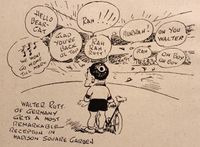
Cartoon: Howard Freeman
Cartoon depicting Walter Rutt's reception at the 1921
six-days bicycle race of New York
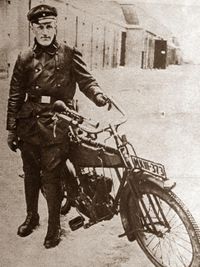
Final in the Sportpalast
In 1925, he won the Berlin Six-Day Race again alongside Emile Aerts. Then the time had come for him to step down from the stage.
His 25 years as a professional cyclist had taken him to 13 European countries, twice to Australia, and nine times to the USA. On the world's velodromes, he had not only recorded 933 victories in countless races, but also 173 serious crashes. The injuries he sustained included a skull base fracture, two skull fractures, nine concussions, some of them severe, 17 different bone fractures, and countless lacerations and abrasions.
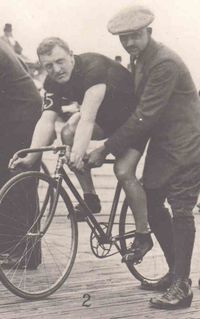
Walter Rutt, held by his longtime coach Flamm
At the age of 42, Walter Rutt hung up his racing bike. On January 12, 1926, he rode his farewell lap at the Sports Press Festival in Berlin's Sportpalast, with the final sprint being led by his son Oskar , who had also become a professional racing cyclist.
The magazine “Illustrierter Radrennsport” commented on the evening with the words: “Once again, times gone by came back to us as the old world champion circled the track for the last time. Once again, we were able to admire the enormous speed of the Rhinelander as he completed the last lap in 11.1 seconds. Many eyes filled with tears as a piece of German cycling history was laid to rest here.”